



Good morning! Welcome to the Canadian AI Newsletter, a weekly rundown for founders, operators and investors.
Was this forwarded to you? Subscribe below.
I am Raif Barbaros, Partner at Mistral Venture Partners. Views are my own.
I also run the Canadian AI Index, a free database of Canadian AI companies, founders, rounds and investors.
Dayforce is buying Toronto’s Ribbon AI, whose AI interviewers screen job candidates by voice and video. I also spotlight Steel, a browser for AI agents built in Toronto that has served more than 35M sessions. PataBid raised $2M in Calgary, Ranovus wants to buy the NRC’s photonics foundry, and 1Password passed US$500M in ARR. Also in this issue: Ottawa’s $1.75B venture plan, bank CEOs on AI agents, and Evan Solomon telling senators that power is a provincial matter. Let’s get into it.
💰 Startups & Deals
Ribbon (Toronto) agreed to be acquired by Dayforce, which will add Ribbon’s voice and video AI interviewers to its HR platform.
Terms weren’t disclosed. CEO Arsham Ghahramani and COO Dave Vu founded Ribbon in 2022, and it raised US$8.2M in early 2025 in a round led by Radical Ventures.
Thoma Bravo took Dayforce private for US$12.3B earlier this year.
I met Arsham and Dave early on; couldn’t happen to nicer and smarter people. Congrats!
Steel (Toronto) is one of the leading browsers for AI agents, and most of us haven’t heard of it.
Every once in a while I meet Canadian founders building something here that’s reaching scale that most of us haven’t heard of. Hussien Hussien and Nasr Mohamed are U of T and Waterloo grads who worked in San Francisco, then moved back to Toronto to build Steel.
Steel’s API spins up cloud browsers for agents, with anti-bot handling, CAPTCHA solving and saved logins built in. Its open-source browser has 7.9K stars on GitHub.
Steel has served more than 35M browser sessions for customers including Readwise, Cognizant and Profound.
PataBid (Calgary) raised a $2M pre-seed led by Graphite Ventures for AI that does construction cost estimates.
Sprout Fund, Bluesky Equities and Inverted Ventures joined. Its estimating agent, Newton, is in beta, with a launch planned for 2027.
Ranovus (Ottawa) is launching a venture arm, and CEO Hamid Arabzadeh says its first target is the NRC’s Canadian Photonics Fabrication Centre.
Ranovus makes optical chips that move data inside AI data centres. The NRC is spinning out the foundry.
Blue J (Toronto) plugged its tax research into Legora on October 19, so lawyers who use both get cited Blue J answers inside Legora. (Disclosure: Blue J is a Mistral Venture Partners portfolio company.)
The integration runs on MCP. Selected joint customers get early access now, with general availability planned for November. Blue J says more than 6,000 organizations use it.
🏢 Large Companies
1Password (Toronto) passed US$500M in annual recurring revenue and launched 1Password for Agents for personal AI agents that log in to accounts.
Use of its developer and AI security tools is up 200% from a year ago, and non-human use is up 500%. It passed US$400M in November 2025.
Canada’s bank CEOs set out where they stand on consumer AI agents.
RBC’s Dave McKay said RBC may block Meta’s Muse agent from customer accounts. RBC’s head of AI, Bruce Ross, said agents won’t get access without safeguards. BMO’s Darryl White told customers not to give AI agents their banking information. Given that Amazon too recently blocked agents from placing orders, this isn't surprising.
🏛️ Policy
Ottawa launched its $1.75B Venture and Growth Capital Plan: $1B for a new Growth VCCI and $750M for an early- and growth-stage strategy run through BDC.
The Growth VCCI splits into a $700M fund of funds, $200M for life sciences and $100M for emerging managers. BDC’s piece puts $75M into pre-seed and seed and $675M into later stages.
The plan is bigger than Ottawa’s last three VC programs combined, at $1.75B vs. $1.21B committed in 2013, 2017 and 2021, and still ahead after inflation.
Most later-stage rounds in Canada are led by foreign funds; that’s just a fact. Even for Canadian AI companies. I pulled it from the Canadian AI Index: Since 2023, foreign investors led 71% of Canadian AI rounds over C$50M, and Canadians led 20%. Under C$5M, Canadian investors led 50%.
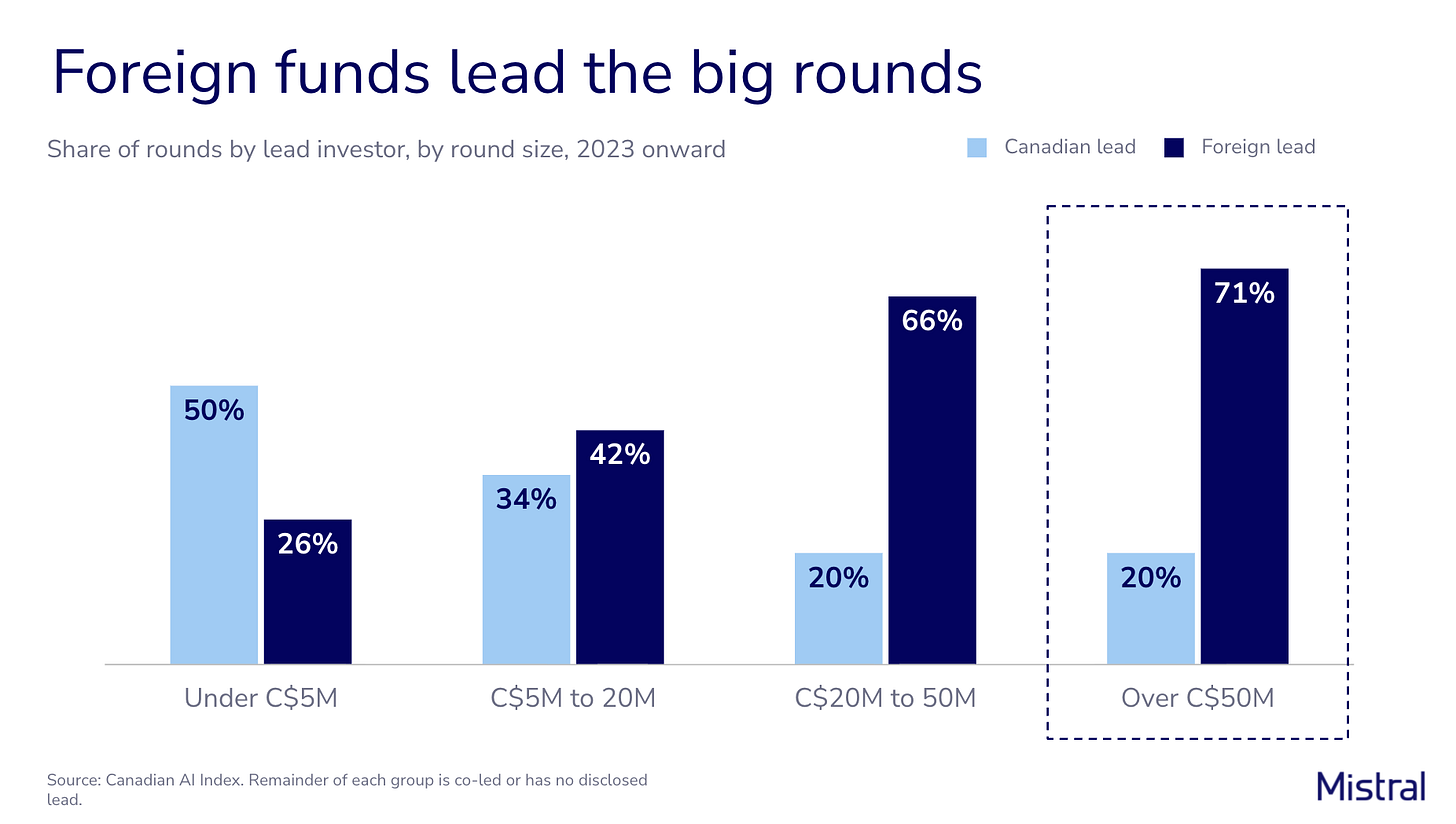
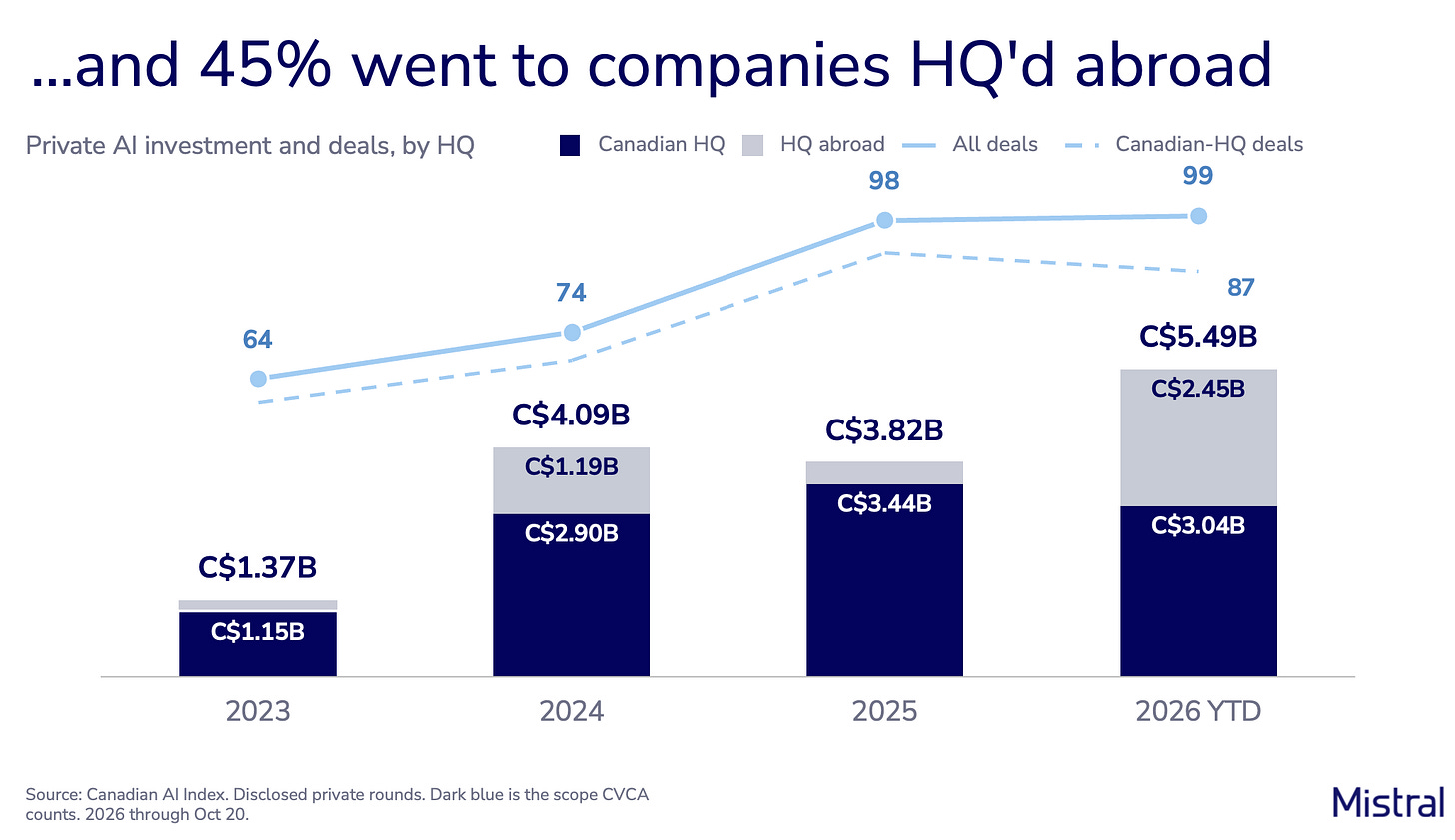
What the data shows is a significant portion of the most successful Canadian AI companies end up with HQs outside of the US. There was some robust debate heading into this whether this new money should focus on the pre-seed and seed stages or later.
I invest at pre-seed and seed and would love more capital, but the gap is clear. A meaningful share of this new capital will go to Canadian AI companies in the later stages and will help keep them Canadian longer.
News Media Canada said it’s very concerned about Meta’s new terms of service after reports that they could let Meta scrape publishers’ sites for AI training.
Meta has since revised the terms. European and British publishers have asked regulators to step in.
PrairiesCan opened its share of the expanded Regional AI Initiative to businesses in Alberta, Saskatchewan and Manitoba. Applications are open until December 31, 2029.
🖥️ Data Centres
AI Minister Evan Solomon told a Senate committee on Thursday that the federal government “is not responsible for power” and can’t regulate how much electricity AI data centres use.
He said Saskatchewan and Nova Scotia are writing their own data-centre laws.
Nova Scotia won’t require an environmental assessment for EverWind’s planned data-centre campus in Point Tupper, where Anthropic is the first tenant.
Premier Tim Houston said written agreements with EverWind will come later. EverWind is also in a land-fee dispute in N.L. over a failed wind-hydrogen project.
Alberta will bring in data-centre legislation this fall, Government House Leader Joseph Schow said.
In a CBC-commissioned poll last month, 7% of Albertans strongly supported AI data centres and 31% strongly opposed them.
📊 Data
Chateau Mojo (Otterburn Park, Que.) checked the robots.txt files of 388 Canadian websites. Seven in 10 news sites ask AI crawlers to stay out, and none of the banks, insurers or fintechs do.
The Canadian AI Index shows 70% of AI venture dollars since 2023 went to 10 of 263 companies.
Tenstorrent, Clio and Cohere alone took 48%. (Disclosure: Cohere is a Mistral Venture Partners portfolio company.) Counts cover disclosed private rounds from January 2023 to October 20, 2026.
📰 In brief
Amazon used an AI tool called Atlas to score unionization risk at its Canadian warehouses, according to documents from B.C. Labour Relations Board hearings with Unifor.
Thomson Reuters (Toronto) launched an agentic CoCounsel for tax, audit and accounting.
Coles picked Coveo (Québec City) for AI search on its online grocery site.
Moov AI (Montréal) and Nurun merged into MOOV, an AI transformation firm inside Publicis Canada.
Arcanus Aerial Systems (Toronto) signed a five-year exclusive deal to supply drones for Germany’s NeuralDrones and its AI wildfire detection.
Railtown AI (Vancouver) open-sourced its Railtracks agent kit for Swift, the language Apple developers use.
Verano.AI (Calgary) launched a tool that links regulatory changes to compliance tasks.
Ontario voters turned to AI chatbots for help choosing candidates in Monday’s municipal elections.
Les Éditions du Boréal dropped author Thélyson Orélien after saying it found evidence he used AI to write his debut novel.
Nova Scotia’s association of more than 40 farmers’ markets is drafting a ban on AI-generated art and promotional materials.
New on the Canadian AI Index: Steel and Verano.AI.
The Canada–EU Summit is this Thursday and Friday in Montréal, and the federal budget lands November 5.
Thank you for reading! Subscribe, and please share any feedback 🙏🏽
— Raif